 AxenCor
Before feasibility: seven questions that decide go / no-go for an industrial project in Angola
AxenCor insight · method · 7-minute read
A full feasibility study takes time, specialists and a significant budget. It should not be the way to discover an obstacle that a few weeks of work could have revealed. Before commissioning one, AxenCor asks seven questions. For each: what must be demonstrated, the minimum information needed, and the signals that lead to continuing, redirecting or stopping.
Why qualify before studying
At the very start of a project, information is scarce and figures are wide. According to AACE International, a Class 5 cost estimate — concept screening, with 0 to 2% of project definition — may fall −20% to −50% below and +30% to +100% above the final cost. A Class 4 estimate, at the study or feasibility stage, still ranges from −15% to −30% and +20% to +50% [1]. AACE notes that these ranges also depend on familiarity with the technology and the quality of reference data.
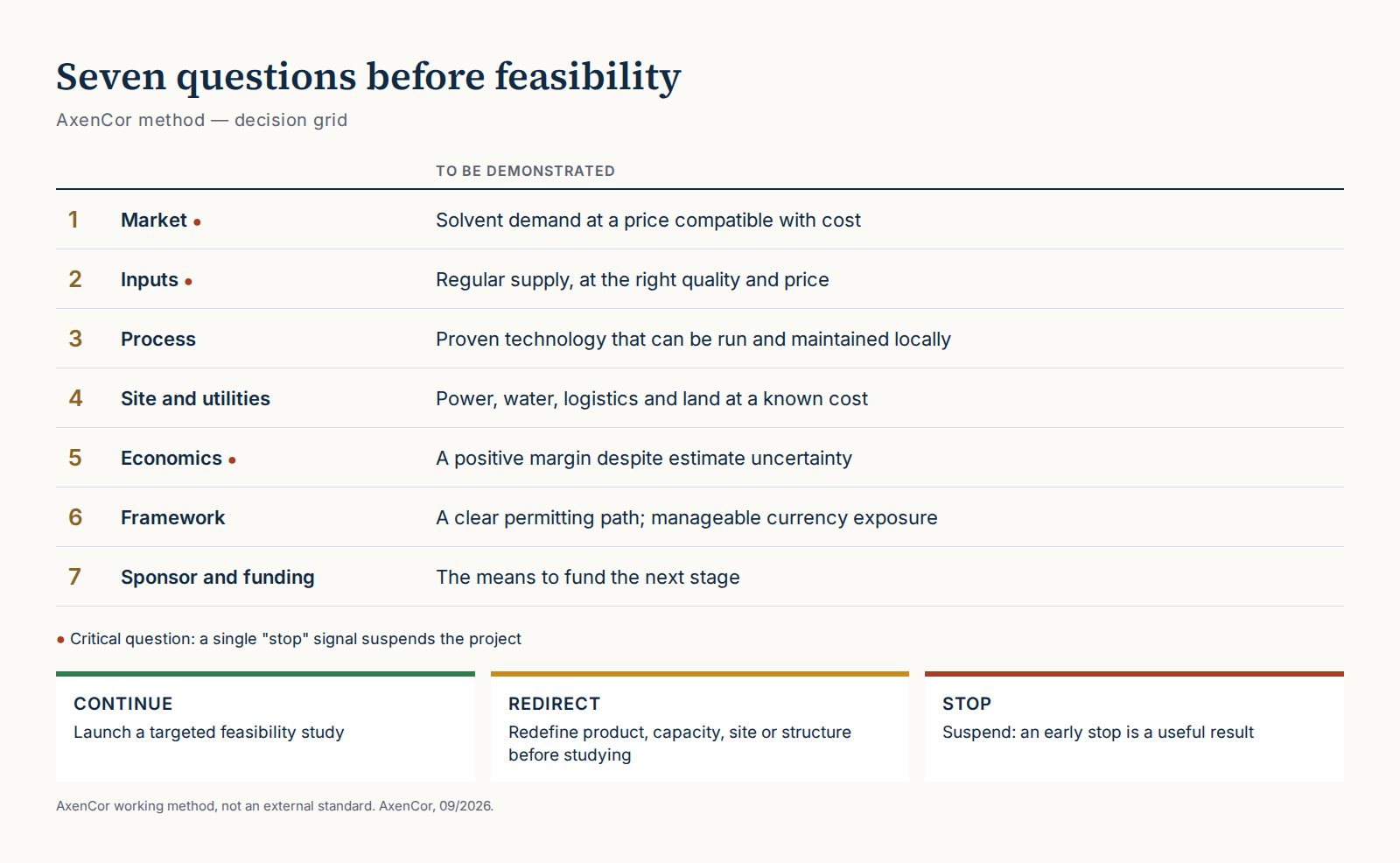
At this stage, the goal is not precision. It is to know whether the uncertainties are acceptable, and which ones must be resolved first. The grid below is AxenCor's working method: it is not a standard, but a sequence of questions we apply to every opportunity.
1. Is there a market for this product, at this price?
Where part of demand is currently met by imports, the reference price is often the landed import price at the customer's gate. That is the price the project must beat, at equal or better quality.
To demonstrate — solvent demand at a price compatible with the target production cost.
Minimum information — identified target customers; volumes; current purchase prices; quality specifications and approval conditions.
Continue if buyers are ready to trial the product or sign a letter of intent.
Redirect if demand exists, but for another product, grade or segment.
Stop if no buyer is willing to commit, or the target price stays below cost.
2. Are inputs secured?
Local processing does not always remove import dependence: it can shift it to raw materials, reagents or spare parts.
To demonstrate — regular supply, at the right quality and price, over the life of the project.
Minimum information — local or imported sources; quality; volumes; price and invoicing currency; lead times; fallback options.
Continue if at least one reliable source and one credible alternative are identified.
Redirect if the input is only available in another form or from another origin, affecting process or cost.
Stop if a critical input has neither a reliable source nor a substitute.
3. Is the process proven and suited to the context?
A technology that performs elsewhere must also be operable and maintainable on site, with the skills and spare-parts logistics available.
To demonstrate — a technology proven at the target scale, operable and maintainable locally.
Minimum information — comparable industrial references; identified manufacturers; skills, spare-parts and maintenance needs.
Continue if the technology is referenced, several manufacturers can supply it and maintenance can be organised.
Redirect if capacity or level of automation must be revisited for the local context.
Stop if there is no reference at this scale, or maintenance is impossible on site.
4. Are the site and utilities realistic?
Power, water and logistics access often weigh more in site selection than the land itself.
To demonstrate — an accessible site with power, water and logistics available at a known cost.
Minimum information — required load and consumption; supply options and costs; water needs; road, rail or port access; land.
Continue if utilities are available, or a self-generation solution has been costed.
Redirect if another site, another energy source or a phased capacity is needed.
Stop if the power or logistics requirement is incompatible with any accessible site at acceptable cost.
5. Do the economics hold at order-of-magnitude level?
Given the ranges above, a project that only shows a margin in the most favourable case is not ready for feasibility.
To demonstrate — a positive margin in the base case and controlled sensitivity to key assumptions.
Minimum information — screening-level capital and operating cost estimate; selling price; key assumptions and their range.
Continue if the margin stays positive once estimate uncertainty is taken into account.
Redirect if profitability only appears with a different capacity, product or configuration.
Stop if the project is not viable even in the favourable case, or rests on a single fragile assumption.
6. Are the regulatory and currency frameworks understood?
In Angola, private investment is governed by Law No. 10/18, amended by Law No. 10/21 of 22 April 2021, which notably provides for a contractual regime negotiated with the State and governs the transfer of dividends abroad [2]. Sector-specific licences and permits may apply on top. Analysing them is a matter for specialised legal counsel; at qualification stage, the question is whether the path is identified.
To demonstrate — an identified permitting path and manageable currency exposure.
Minimum information — intended investment regime; sector and environmental licences required; currency of revenues and costs; transfer conditions.
Continue if the permitting path and its timeline are known, and the planned financial flows fit within the legal framework.
Redirect if the legal structure, location or partnership with a local partner must be adapted.
Stop if a blocking authorisation has no visibility, or currency risk cannot be hedged on a project financed in foreign currency.
7. Are the sponsor and funding equal to the project?
Financiers look at the project, but also at who stands behind it: ability to fund development, governance, equity commitment.
To demonstrate — the ability to fund the development phase and a structure credible to future financiers.
Minimum information — available equity; budget for the next studies; governance; types of financiers suited to the project's size.
Continue if equity and the budget for the next studies are in place.
Redirect if a co-investor or industrial partner must be found first.
Stop if no equity is available and no way to fund the next stage has been identified.
Reading the result
- Continue — all seven questions have a sufficient answer: feasibility can start, focused on the remaining uncertainties.
- Redirect — one or more points call for a redefinition (product, capacity, site, structure). Several redirect signals mean the project must be redefined before any feasibility work.
- Stop — a single stop signal on a critical question — market, inputs or economics — is enough to suspend the project. An early stop is a useful result: it protects the sponsor's budget and credibility.
AxenCor perspective
This qualification is the first step of our method. It comes before the feasibility study and sets its scope: what is already established, what remains to be demonstrated, and what is not worth studying.
Have an industrial project to qualify? → Submit a project · → Our Industrial Strategy service
This article presents a working method. It does not constitute legal, tax or investment advice.
- [1] AACE International, RP 18R-97, rev. 7 August 2020, Table 1.
- [2] Republic of Angola, Law No. 10/21 of 22 April 2021 amending Law No. 10/18 of 26 June 2018 (Private Investment Law), Diário da República, Series I, No. 71.